Aeolus Truck & Driver News

Mahle makes progress on H2 ICE emissions
Aeolus Truck & Driver News
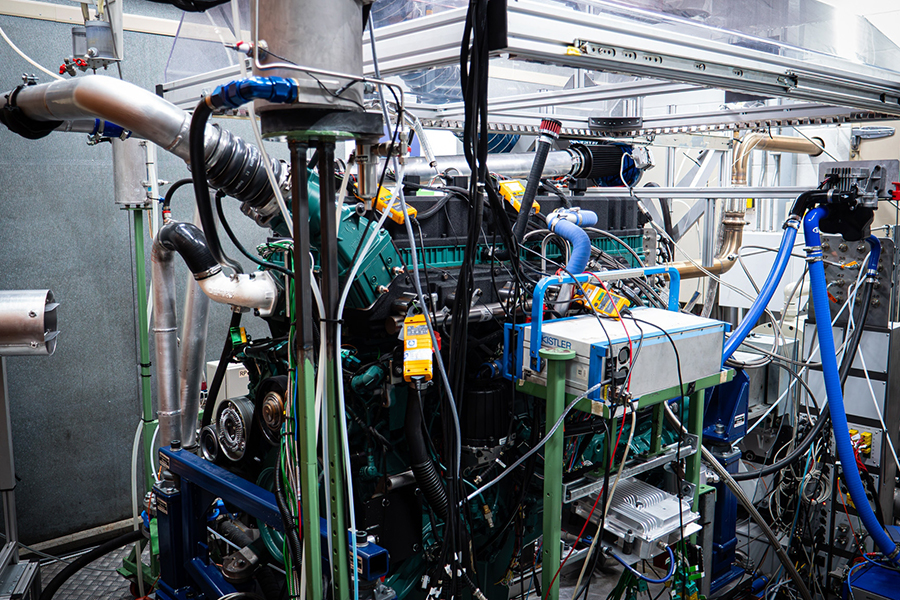
Mahle Powertrain has achieved a major milestone in Project Cavendish, successfully converting a 13-litre heavy-duty engine to run purely on hydrogen.
The converted engine has matched the maximum torque of the diesel baseline engine while measured engine-out NOx suggests that emissions can be readily maintained below 0.2g/kWh across the entire engine operating map using existing aftertreatment technology.
Launched in early 2023, Project Cavendish is a £9.8 million (NZ$22.5m) programme supported by the Advanced Propulsion Centre UK (APC) that is developing end-to-end hydrogen powertrain capability for heavy-duty applications, supporting the UK’s transition towards net-zero transport. As part of Project Cavendish, Mahle Powertrain has upgraded its testing infrastructure in Northampton for hydrogen operation.
...Mahle Powertrain has achieved a major milestone in Project Cavendish, successfully converting a 13-litre heavy-duty engine to run purely on hydrogen.
The converted engine has matched the maximum torque of the diesel baseline engine while measured engine-out NOx suggests that emissions can be readily maintained below 0.2g/kWh across the entire engine operating map using existing aftertreatment technology.
Launched in early 2023, Project Cavendish is a £9.8 million (NZ$22.5m) programme supported by the Advanced Propulsion Centre UK (APC) that is developing end-to-end hydrogen powertrain capability for heavy-duty applications, supporting the UK’s transition towards net-zero transport. As part of Project Cavendish, Mahle Powertrain has upgraded its testing infrastructure in Northampton for hydrogen operation.
“This milestone demonstrates that hydrogen combustion has a place as a clean fuel in the heavy-duty market,” says Jonathan Hall, Head of Research and Advanced Engineering at Mahle Powertrain.
“Achieving the target torque and low raw engine out emissions from a hydrogen fuelled 13-litre heavy-duty engine represents a significant step forward, both for Mahle Powertrain and for the wider industry, as we move towards practical hydrogen combustion solutions for heavy-duty applications.”
Achieving target torque was just the first step – the bigger challenge in hydrogen combustion is controlling NOx emissions.
The measured raw engine out emissions are very low and the addition of a simple Selective Catalytic Reduction (SCR) aftertreatment system will enable the tailpipe emissions to be significantly less than EU VII limits.
The measured particulate emissions were negligible and readily manageable using existing particulate filter technology. The results demonstrate that hydrogen combustion engines offer a practical, fast-to-market pathway towards zero-carbon heavy-duty transport.
Project Cavendish also aims to facilitate wider hydrogen adoption by creating opportunities for external partners to undertake hydrogen engine testing at Mahle Powertrain’s facility in Northampton, demonstrating the UK’s commitment to developing clean, practical solutions for the heavy-duty transport sector.
The state-of-the-art facilities serve as a centre of excellence for the design, development, calibration, and testing of all aspects of hydrogen and renewable fuels powertrain engineering.
Mahle Powertrain reports growing interest from new customers and expects commercialisation of its hydrogen and renewable fuels infrastructure to expand significantly over the coming year.


 + EQUIPMENT GUIDE - FREE