First U.S. Highway Segment Wirelessly Powers Electric Heavy-Duty Truck at Speed
Posted: 15-Jan-2026 |
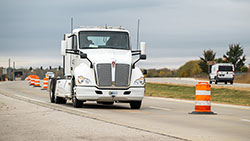
Engineers at Purdue University have successfully demonstrated the first U.S. roadway capable of wirelessly charging a heavy-duty electric truck while it travels at highway speeds. This milestone, achieved on a quarter-mile segment of U.S. Highway 52/U.S. Highway 231 in West Lafayette, Indiana, marks a significant step toward electrified highways that could recharge vehicles of all sizes across the nation.
The experimental system, developed by Purdue researchers in collaboration with the Indiana Department of Transportation (INDOT), delivered an impressive 190 kilowatts of power to an electric semitractor provided by Cummins as it cruised at 65 miles per hour. "To put that in perspective, 200 kilowatts are on the scale of about a hundred homes," explained Steve Pekarek, Purdue’s Edmund O. Schweitzer III Professor of Electrical and Computer Engineering.
The project, initiated in 2018 as part of a multistage research effort funded by INDOT and affiliated with the National Science Foundation's Advancing Self-sufficiency through Powered Infrastructure for Roadway Electrification (ASPIRE) center, addresses the unique challenges of dynamic wireless power transfer for heavy-duty vehicles. Unlike slower city roads tested elsewhere, highways demand higher power levels due to faster speeds, making this demonstration particularly innovative.
Purdue's patent-pending design embeds transmitter coils within concrete pavement, which transmits power via magnetic fields to receiver coils on the truck's underside, much like a smartphone charging on a pad, but at thousands of times the power. Dionysios Aliprantis, a Purdue professor of electrical and computer engineering, noted the complexity: “Transferring power through a magnetic field at these relatively large distances is challenging. And what makes it more challenging is doing it for a heavy-duty vehicle moving at power levels thousands of times higher than what smartphones receive”.
Focusing first on trucks (which contribute the most to U.S. freight transportation) allows the system to scale down for passenger vehicles, potentially reducing battery sizes and alleviating range anxiety for all EVs. "With this system, you’d be able to drive your vehicle down the road and it would charge the battery," said John Haddock, a professor in Purdue’s Lyles School of Civil and Construction Engineering. Smaller batteries could mean lower costs and more cargo capacity for freight haulers, boosting economic viability.
The initiative involved key partners including Cummins, AECOM, White Construction Inc., and PC Krause and Associates. John Kresse, chief technology engineer at Cummins, praised the collaboration: “With its high power and promising cost structure, this technology represents a practical, and potentially game-changing, solution for the future of on-highway commercial transportation”.
INDOT Commissioner Lyndsay Quist highlighted the partnership's potential: “While there is still more to explore, we are seeing what the future could hold for heavy-duty EV charging and transportation”. As a founding member of ASPIRE, Purdue is contributing to industry standards for dynamic wireless power transfer, which could encourage widespread adoption by state transportation departments.
In April 2025, the team received the Technology Innovation Award at the IEEE PES Energy and Policy Forum for their work. Nadia Gkritza, Purdue professor and ASPIRE campus director, emphasized the project's broader impact: “This achievement reflects how our growing ecosystem connects public agencies, private industry and academic research to turn electrification goals into reality”.
This demonstration not only validates the feasibility of wireless highway charging but also positions the U.S. as a leader in sustainable transportation infrastructure. As electric adoption accelerates globally, such innovations could dramatically cut emissions from freight, which accounts for about 28% of U.S. transportation-related greenhouse gases.
Search Articles
Search Trucks Database
NZ Truck & Driver Magazine
Read Now


 + EQUIPMENT GUIDE - FREE